
Last updated: September 2026 · Written by the Car Chasey team
A dash cam is the cheapest insurance you will ever buy. It sits on the windscreen, costs less than a single deductible, and the one time you need footage of what actually happened, it is the difference between your word against theirs and a closed case. The trouble is that the category is flooded — hundreds of near-identical boxes, half of them rebadged from the same factory, all claiming 4K.
This guide cuts that down to eight cameras that are genuinely worth your money in 2026, and tells you plainly which one fits which driver.
Quick picks
| Best overall | ROVE R2-4K Dual Dash Cam — the most recommended all-rounder, front and rear, 128GB card in the box |
| Best value | REDTIGER F7NP 4K — over 25,000 ratings, the most battle-tested camera here |
| Best budget | 1296P 3-Channel Dash Cam — three cameras for the price of one mid-range unit |
| Best premium | VIOFO A229 Plus — dual STARVIS 2 sensors, the best night footage of the group |
How we picked these cameras
We want to be straight with you about our method. We have not personally crash-tested all eight of these cameras, and any site that tells you it has is probably not being honest either.
What we did instead: we pulled the full Amazon Best Sellers list for dash cams in September 2026, then filtered it down on the things that actually predict whether a dash cam will still be working in two years — sensor model rather than marketing resolution, review volume in the thousands rather than the dozens, rating stability, supercapacitor versus lithium battery, and whether the manufacturer has a track record of shipping firmware updates. Every rating and review count on this page was read directly from the live Amazon listing on the date above.
Where a camera has a known weakness, we say so in its Cons. None of these entries were placed or paid for.
Which dash cam should you buy in 2026?
For most drivers the answer is the ROVE R2-4K. It covers front and rear, it ships with the memory card already included, it holds a 4.5-star average across more than 14,000 ratings, and it does not ask you to learn an app before it starts recording. If you drive for Uber or Lyft you want a 4-channel camera instead — the IIWEY N5 — because the interior view is the whole point. If you mostly drive at night, spend up on the VIOFO A229 Plus.
The eight cameras below are ordered by how widely we would recommend them, not by price.
Best overall
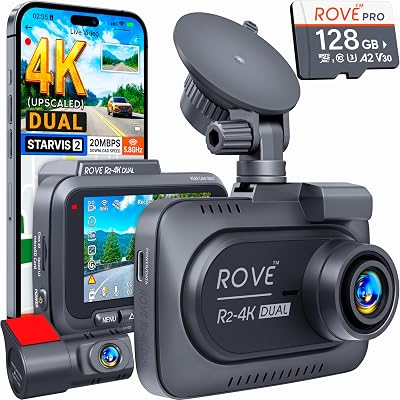
ROVE R2-4K Dual Dash Cam (Front and Rear)
The R2-4K is the camera we would put in a family member’s car without thinking twice about it. It records the road ahead at upscaled 4K and the rear at 1080p, uses a Sony STARVIS 2 sensor so headlights at night bloom far less than on cheaper units, and — unusually for this price — Rove includes a 128GB card rather than selling you one separately.
What earns it the top spot is not any single spec. It is that after 14,000 ratings the average has not sagged, which in this category is rarer than it sounds.
- ✅ 128GB card included — genuinely ready out of the box
- ✅ STARVIS 2 sensor handles night glare well
- ✅ Front and rear coverage as standard
- ✅ Rating has held at 4.5 across a very large sample
- ❌ Rear camera cable run takes real effort on a hatchback or SUV
- ❌ “4K” here is upscaled, not a native 4K sensor
Best value
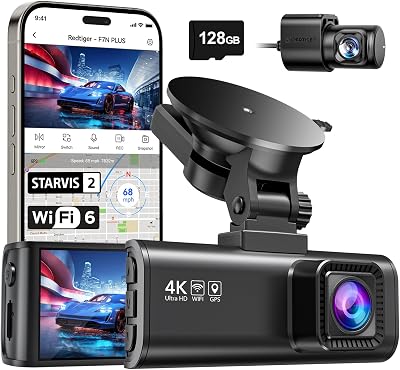
REDTIGER F7NP 4K Dash Cam (Front and Rear)
No other dash cam on this list has been bought and rated as many times as the F7NP. Twenty-five thousand ratings is a sample size that tells you something a spec sheet cannot: this camera survives summers on a windscreen. It pairs a STARVIS 2 sensor with 5.8GHz Wi-Fi, which matters because transferring a ten-minute 4K clip over the older 2.4GHz band is genuinely painful.
The 4.2 average is lower than the ROVE’s, and that is not noise — the app is the weak point, and a minority of buyers report pairing trouble.
- ✅ Largest review base in the category by a wide margin
- ✅ 5.8GHz Wi-Fi makes clip transfer fast
- ✅ Memory card included
- ✅ Frequently the cheapest STARVIS 2 camera available
- ❌ The companion app is the most-complained-about part
- ❌ Parking mode needs a hardwire kit sold separately
Best image quality
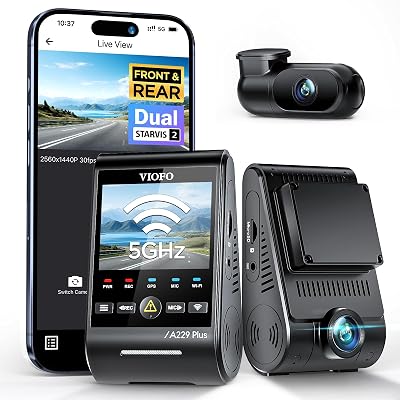
VIOFO A229 Plus (2K Front and Rear)
VIOFO builds cameras for people who care about the footage rather than the box it came in. The A229 Plus puts a STARVIS 2 sensor in both the front and rear units — almost every rival pairs a good front camera with a mediocre rear one — and records 1440p on each with HDR.
In practice that is the difference between “there was a dark car” and a legible plate at 11pm. It costs more than the ROVE and it is not aimed at someone who wants to plug it in and forget it; the settings menu assumes you want control.
- ✅ STARVIS 2 on front and rear, not just the front
- ✅ Best low-light plate legibility of anything here
- ✅ Supercapacitor rather than a lithium battery — far better in heat
- ✅ VIOFO has a long record of firmware support
- ❌ Among the most expensive options on this page
- ❌ Setup menu is deep; not a plug-and-forget camera
Best for rideshare
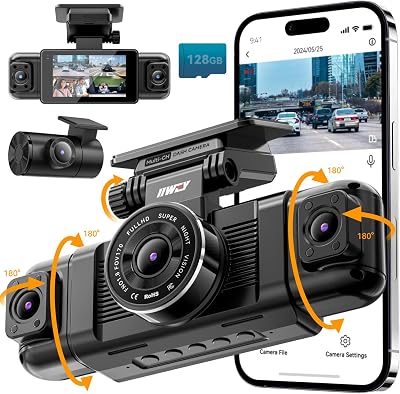
IIWEY N5 4-Channel Dash Cam (360° Coverage)
If you carry passengers for money, a front-and-rear camera covers the wrong half of your risk. The N5 runs four channels — 2K front, 1080p rear, plus interior and side views — and includes a 128GB card, which a four-channel camera burns through quickly.
The interior camera has infrared illumination, so night-time cabin footage is usable rather than a grey smear. Check your local recording-consent rules before you switch that channel on.
- ✅ Genuine 360° coverage — the only one here with it
- ✅ Infrared cabin recording works in the dark
- ✅ 128GB card included
- ✅ 4.4 average across a healthy sample
- ❌ Four channels means four cables and a long install
- ❌ Cabin recording carries consent obligations in some states
Best remote monitoring
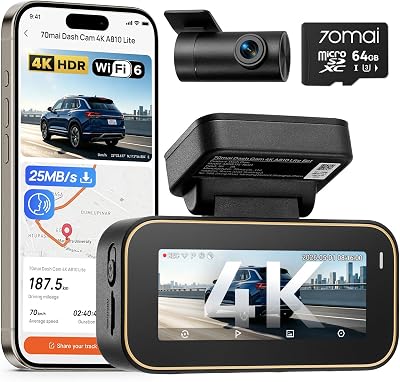
70mai A810 Lite 4K Dash Cam (4G LTE)
Almost every dash cam records for you to watch later. The A810 Lite adds a 4G LTE connection, so you can pull up a live view of the car from anywhere and get a push alert when something bumps it in a car park. Wi-Fi 6 on the 5GHz band makes downloading the resulting clip quick.
The review count is the lowest of our top picks — this is a newer model — so treat the 4.3 as a promising early signal rather than a settled verdict.
- ✅ Live remote view and impact alerts over 4G
- ✅ Wi-Fi 6 for genuinely fast transfers
- ✅ Strong 4K front recording
- ❌ The 4G features need their own data plan
- ❌ Only 716 ratings so far — less proven than the ROVE or REDTIGER
Most discreet
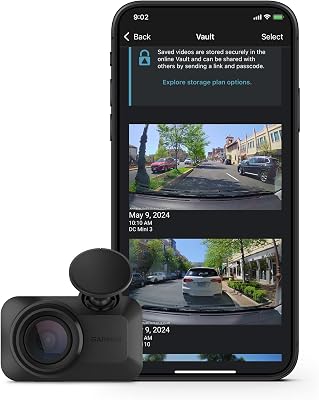
Garmin Dash Cam Mini 3
The Mini 3 is roughly the size of a car key and hides completely behind the rear-view mirror. There is no screen at all — you use the phone app — and that is the point. Garmin’s build quality and app are a clear step above the generic brands, and voice control means you can save a clip without taking a hand off the wheel.
It is 1080p only, and at 4.0 it has the lowest average on this page. You are paying for size and for Garmin’s software, not for resolution.
- ✅ Genuinely invisible behind the mirror
- ✅ Best-in-class app and support
- ✅ Voice control to save a clip hands-free
- ❌ 1080p only — plates are harder to read than on the 2K and 4K units
- ❌ Lowest rating here; no memory card included
Best front-only
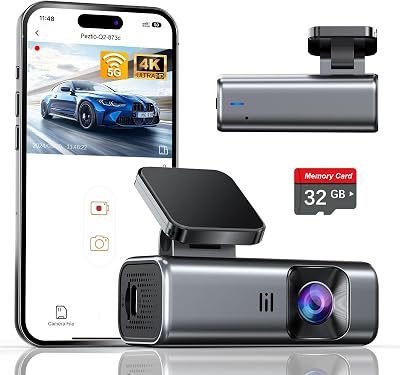
galphi 4K Front Dash Cam (Screen-Free)
Not everyone needs two cameras and a cable run down the headliner. The galphi is a single 4K front unit with no screen, controlled entirely from the app, and it ships with a 32GB card. For a commuter car it covers the scenario that actually generates insurance claims — the vehicle in front of you.
A 4.4 average across 1,500 ratings is a solid showing for a brand most people have never heard of.
- ✅ 4K front recording at a front-only price
- ✅ Screen-free design is very discreet
- ✅ 5GHz Wi-Fi and a card in the box
- ❌ No rear camera and no option to add one
- ❌ No screen means every check goes through the phone
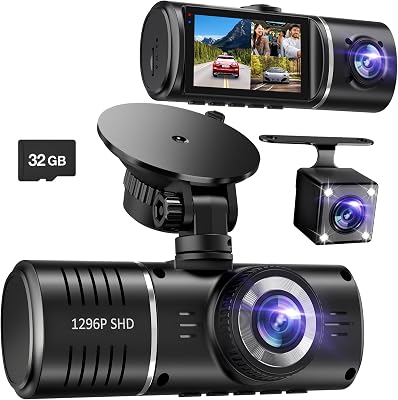
Best budget
1296P 3-Channel Dash Cam (Front, Rear and Inside)
Three channels at the price most brands charge for one is the entire pitch here, and 7,000 ratings say plenty of people have taken it. Front, rear and cabin at 1296P, with a 32GB card included.
The 4.0 average is honest about what you are getting — the night footage is noticeably softer than the STARVIS 2 cameras above, and long-term reliability reports are mixed. But a working budget camera in the car beats a premium one still in the shopping basket.
- ✅ Three channels at an entry-level price
- ✅ Card included
- ✅ 7,000 ratings — well established despite the price
- ❌ Night footage is clearly behind the STARVIS 2 units
- ❌ Mixed reports on how long it lasts
How do these eight dash cams compare?
The table below puts every pick side by side. Channels and sensor matter more than the headline resolution — a 2K STARVIS 2 camera reads a number plate at night better than most “4K” cameras do.
| Camera | Channels | Rating | Best for | Buy |
|---|---|---|---|---|
| ROVE R2-4K | Front + rear | 4.5/5 (14,106) | Best overall | Amazon → |
| REDTIGER F7NP | Front + rear | 4.2/5 (25,824) | Most proven | Amazon → |
| VIOFO A229 Plus | Front + rear | 4.3/5 (2,192) | Night footage | Amazon → |
| IIWEY N5 | 4-channel 360° | 4.4/5 (2,582) | Rideshare | Amazon → |
| 70mai A810 Lite | Front + rear | 4.3/5 (716) | Remote 4G view | Amazon → |
| Garmin Mini 3 | Front only | 4.0/5 (1,199) | Most discreet | Amazon → |
| galphi 4K | Front only | 4.4/5 (1,514) | Front-only 4K | Amazon → |
| 1296P 3-Channel | 3-channel | 4.0/5 (7,018) | Tightest budget | Amazon → |
Ratings and review counts read from the live Amazon listings in September 2026. Prices change constantly, so we do not print them — tap through to see the current price.
What should you look for in a dash cam?
Four things decide whether a dash cam is worth owning, and resolution is not the first of them. The sensor determines night performance, the power source determines whether it survives summer, the channel count determines what you can prove, and parking mode determines whether it protects the car while you are not in it.
The sensor matters more than the resolution
“4K” on the box tells you how many pixels get written to the card, not how much useful detail the lens and sensor captured in the first place. A Sony STARVIS 2 sensor recording 1440p will read a number plate under streetlights that a cheap 4K sensor turns into a white blur. When two cameras are close on price, take the better sensor over the bigger number every time.
Supercapacitor, not lithium battery
A dash cam lives on a windscreen in direct sun. Lithium batteries swell and fail in that environment, and a swollen battery in a sealed plastic case is a genuine hazard. A supercapacitor holds just enough charge to close the video file safely when power cuts, and shrugs off heat. If a listing does not say which it uses, assume lithium.
Decide how many channels you actually need
Front-only covers the crash you are most likely to have. Front and rear covers being rear-ended, which is the claim people most often struggle to prove. Interior only matters if you carry passengers for money or want evidence of what happened inside the car. Every extra channel adds install time and eats card space faster.
Parking mode needs hardwiring to be real
Almost every camera advertises parking mode. Most cannot use it from a cigarette-lighter socket, because that socket dies when you turn the key. Real parking surveillance needs a hardwire kit into the fuse box with low-voltage cutoff so it cannot flatten your battery. Budget for the kit and, unless you are comfortable behind the dash, for a workshop to fit it.
Common mistakes buyers make
The three that cost people footage: using the microSD card that came with an old phone instead of a high-endurance card rated for continuous rewriting; never once checking that the camera is still recording, so the first time they look is after the accident; and mounting the camera where the wiper does not reach, leaving the lens looking through a smeared strip of glass. Format the card every couple of months and check the live view occasionally — that is the whole maintenance routine.
Frequently asked questions
Do dash cams drain your car battery?
Not while you are driving — the car’s alternator powers them. They only draw on the battery in parking mode, and only if hardwired. A properly installed hardwire kit includes a low-voltage cutoff that shuts the camera off before the battery drops too far to start the engine. Plugged into a cigarette-lighter socket that switches off with the ignition, a dash cam cannot drain anything.
Is a dash cam worth it for an ordinary driver?
Yes, for one reason: disputed liability. If someone brake-checks you, reverses into you and claims you hit them, or drives off after clipping your wing mirror, footage ends the argument instantly. A mid-range camera like the ROVE R2-4K costs a fraction of a typical deductible and needs no subscription.
Does a dash cam record when the car is off?
Only if it is hardwired to a constant-power fuse and has parking mode enabled. On standard cigarette-lighter power the camera shuts down with the ignition in most cars. If parking surveillance is what you want, budget for a hardwire kit — or pick a camera like the 70mai A810 Lite that adds remote alerts on top.
What size memory card does a dash cam need?
128GB is the practical sweet spot for a front-and-rear 4K camera, and 256GB if you run four channels or keep parking mode on. The capacity matters less than the type: buy a high-endurance microSD card built for continuous overwriting. An ordinary card will fail within months in a dash cam, usually silently.
Are dash cams legal in the US?
Recording the road is legal in every state. Two things vary: windscreen mounting rules — some states restrict how much glass an accessory may obstruct, which is an argument for a compact unit like the Garmin Mini 3 — and audio or interior recording, which in all-party-consent states requires telling your passengers. Check your own state before switching on a cabin camera.
Do dash cams lower your insurance premium?
In the US, rarely as a direct discount — very few carriers offer one. The real financial benefit is indirect: clear footage settles a disputed claim in your favour, which protects your no-claims standing and stops a premium increase you did not deserve. Treat any discount as a bonus, not the reason to buy.
4K or 2K — which should you buy?
Buy the better sensor, not the bigger number. A 2K camera using a Sony STARVIS 2 sensor, like the VIOFO A229 Plus, produces more legible night footage than most 4K cameras with budget sensors, and its files are smaller so a card holds more history. Only pay for 4K when it comes with a good sensor attached.
Will a dash cam get stolen from my car?
It happens, which is a real argument for the discreet options. A Garmin Mini 3 tucked behind the mirror is invisible from outside the car; a large screen-equipped unit is visible from the pavement. Whichever you choose, take it off the mount when you park in a high-risk area — the suction mount stays, the camera comes with you.
How long does dash cam footage stay on the card?
Dash cams loop-record, overwriting the oldest clips once the card fills. A 128GB card in a front-and-rear 4K camera typically holds four to eight hours before it starts recycling. Anything the G-sensor flags as an impact is locked into a protected folder that loop recording cannot overwrite — but move important clips off the card the same day, because a protected folder that fills up stops protecting.
Final verdict
If you want one recommendation and no further reading: buy the ROVE R2-4K. It covers front and rear, the memory card is in the box, the STARVIS 2 sensor handles night driving properly, and a 4.5-star average across more than 14,000 ratings is the strongest signal in this category that a camera keeps working long after the honeymoon.
Drive for a rideshare platform? Take the IIWEY N5 instead — you need the cabin on record. Drive mostly after dark? The VIOFO A229 Plus is worth the extra. On a tight budget? The 1296P 3-channel unit is imperfect but real, and a working camera beats a perfect one you did not buy.